ART EDUCATION · PREMISES ACQUISITION · DEBT FINANCING
Growth had to fit the timetable.
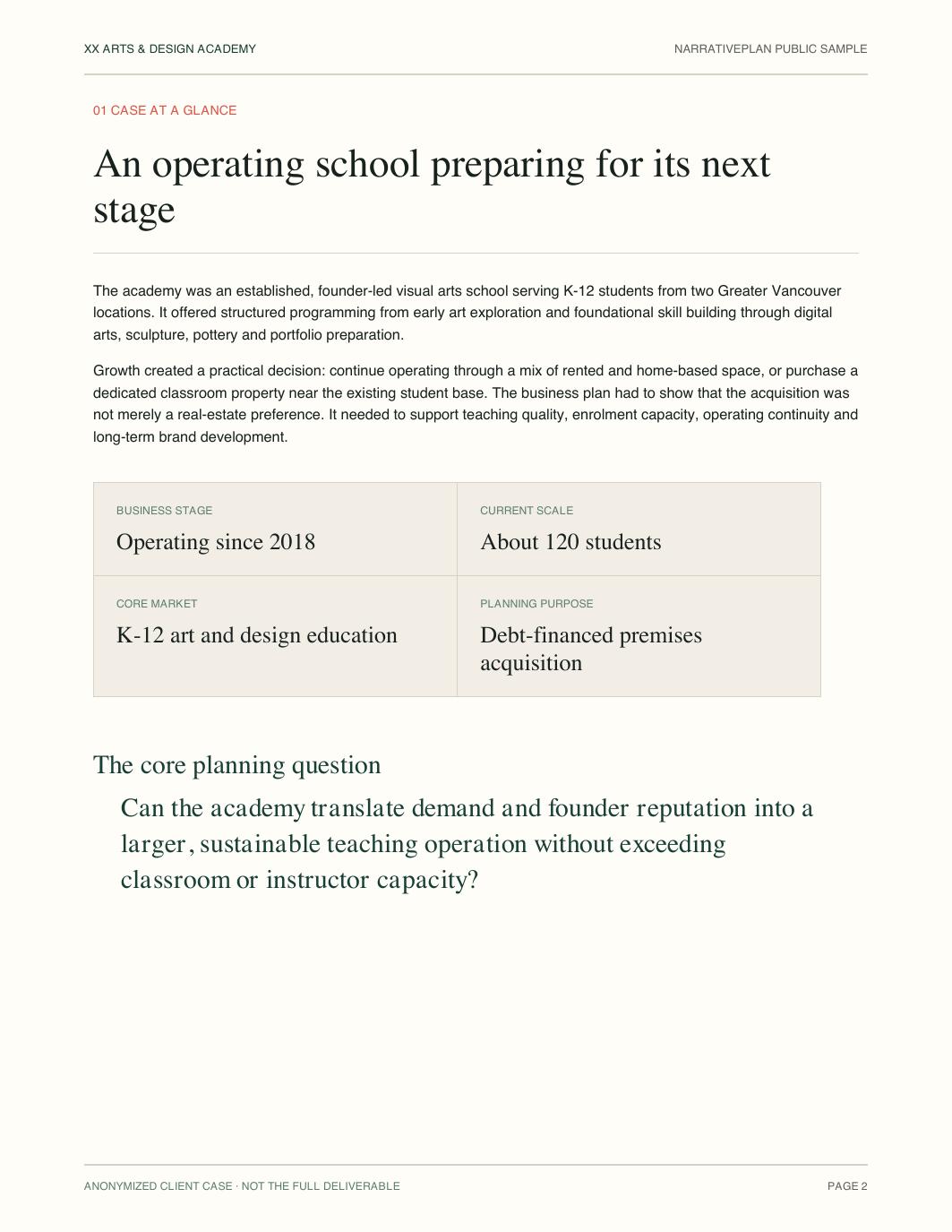
XX Arts & Design Academy was already teaching about 120 K-12 students. The planning challenge was to show how a dedicated classroom purchase could support the next stage of growth without exceeding room capacity, instructor availability or the founders' sustainable workload.
 ANONYMIZED SAMPLE
THE PLANNING CHALLENGE
A property purchase is not a growth strategy by itself.
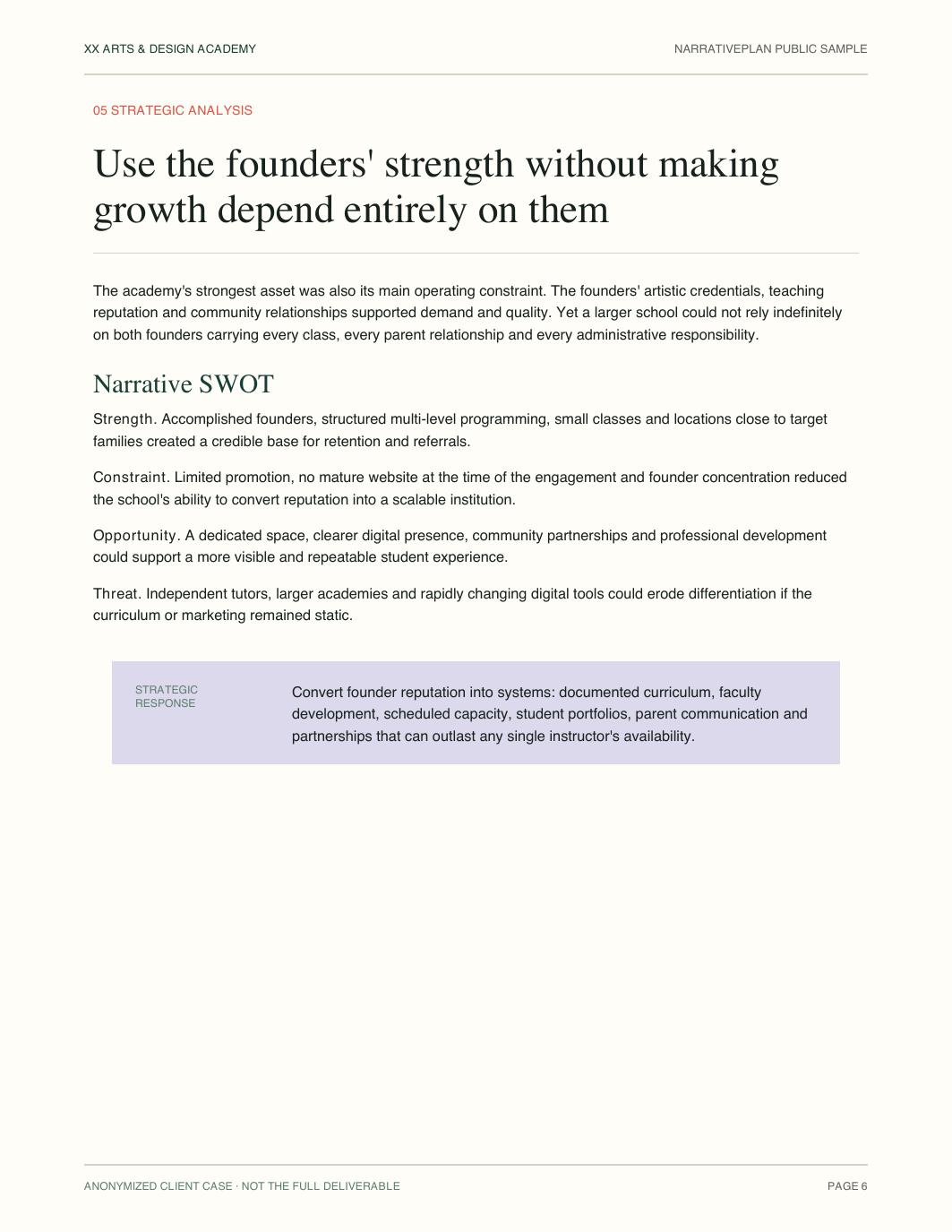
The academy had an operating history, experienced founders, multiple programs and an established student base. It also faced a familiar founder-led constraint: reputation and instructional quality were concentrated in the same two people whose time limited the number of classes the school could deliver.
The business plan therefore could not justify the acquisition merely by arguing that ownership was preferable to rent. It had to connect the new space to program delivery, student retention, class scheduling, instructor development, marketing and the gradual transfer of selected teaching hours to contract faculty.
THE STRATEGIC THESIS
Use the founders' reputation to build the institution - without making the institution permanently dependent on every hour of their time.
THE METHOD
Translate enrolment into an operating schedule before forecasting revenue.
- Map the program ladder.
Early exploration, foundational skills, digital and three-dimensional media, and portfolio preparation were treated as connected stages serving different ages, goals and price points.
- Research the market and alternatives.
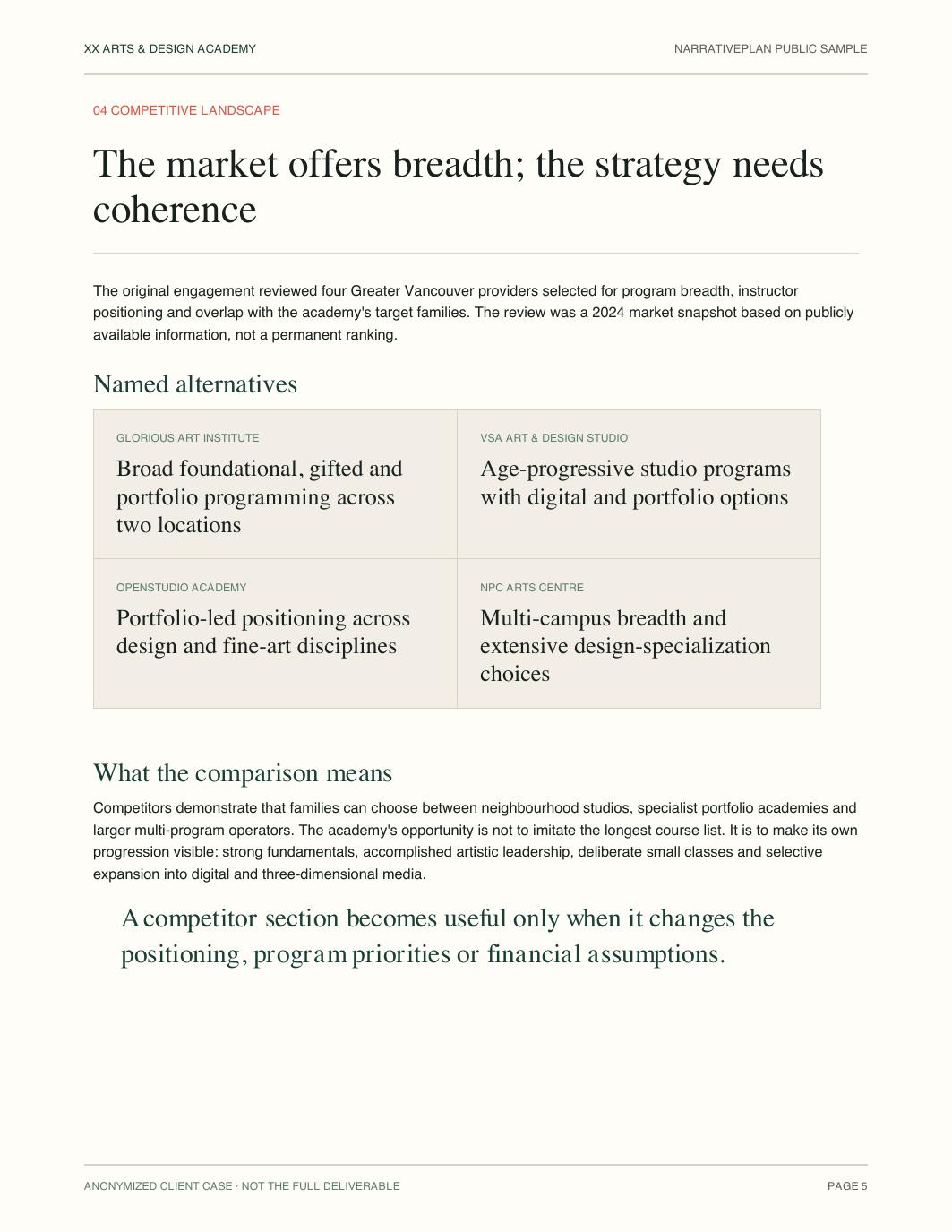
The plan reviewed private art-education trends and four named Greater Vancouver providers, using public program breadth, specialization and location to clarify positioning.
- Build the capacity bridge.
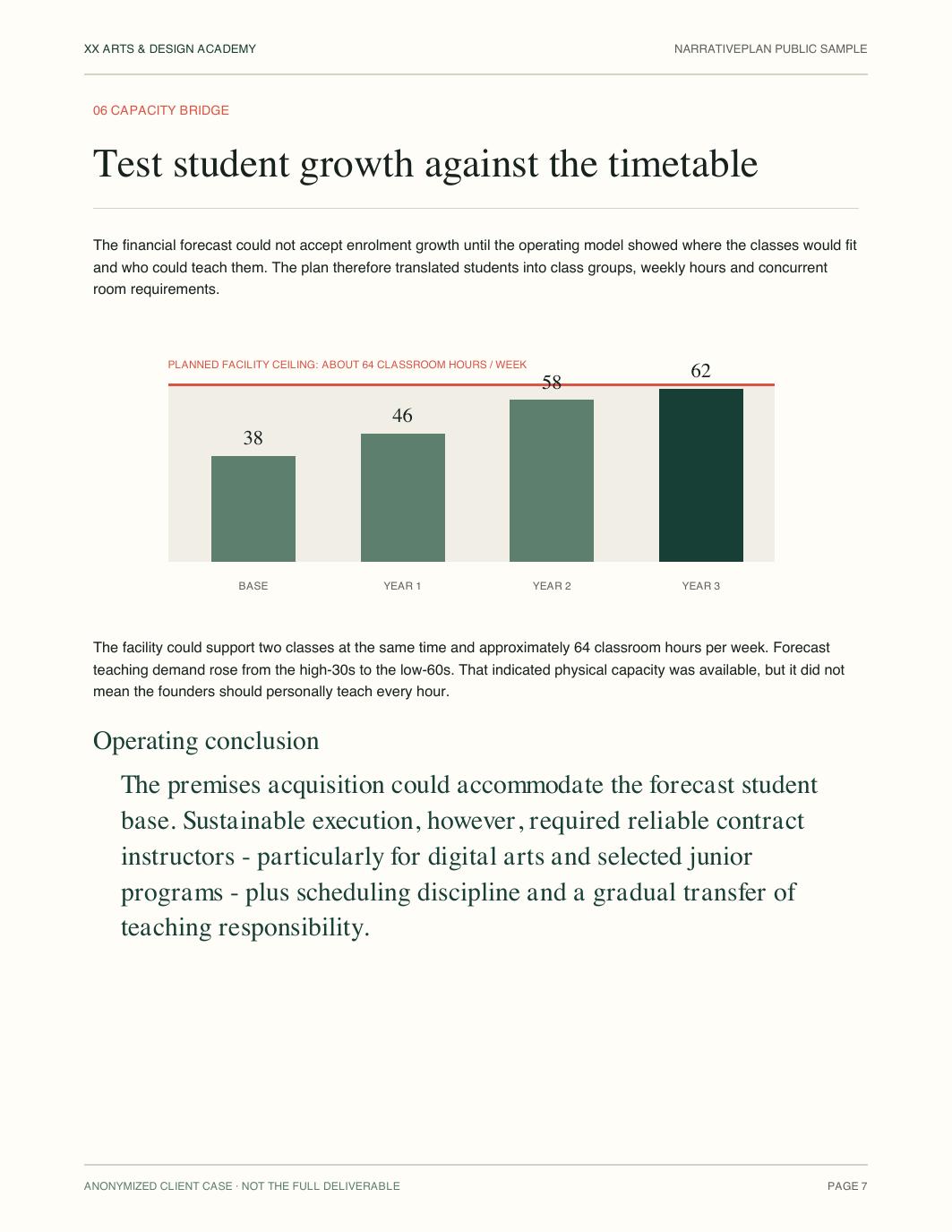
Projected students were converted into class groups, weekly classroom hours and concurrent room requirements. Demand rose from the high-30s to the low-60s in weekly teaching hours against facility capacity of roughly 64.
- Separate room capacity from founder capacity.
The space could support the forecast. Asking two founders to personally teach every available hour would not. Contract instructors and documented curriculum were therefore operating requirements, not optional payroll.
- Connect the property to execution.
The acquisition, opening timetable, family communication, website, community partnerships, faculty development and enrolment tracking became one implementation sequence.
THE COMPLETED WORK
A growth plan grounded in delivery capacity.
This engagement was completed in 2024 by the consulting practice behind NarrativePlan, before the current platform was productized. It is included because its capacity logic became one of the standards now built into NarrativePlan's quality system.
Outcome boundary: this case describes the planning engagement and its completed deliverable. It does not state or imply that financing or the property transaction was approved. The client identity and transaction details have been removed.
THE ANONYMIZED SAMPLE
See how the operating logic reads.
The 9-page public excerpt is adapted from the original engagement. It preserves the strategic reasoning while excluding the client name, founders, address, student identities, purchase price, loan amount and detailed projections.
This excerpt is a privacy-conscious adaptation, not a facsimile of the confidential client document. Public market facts reflect the original 2024 planning period and should be refreshed before a current decision.